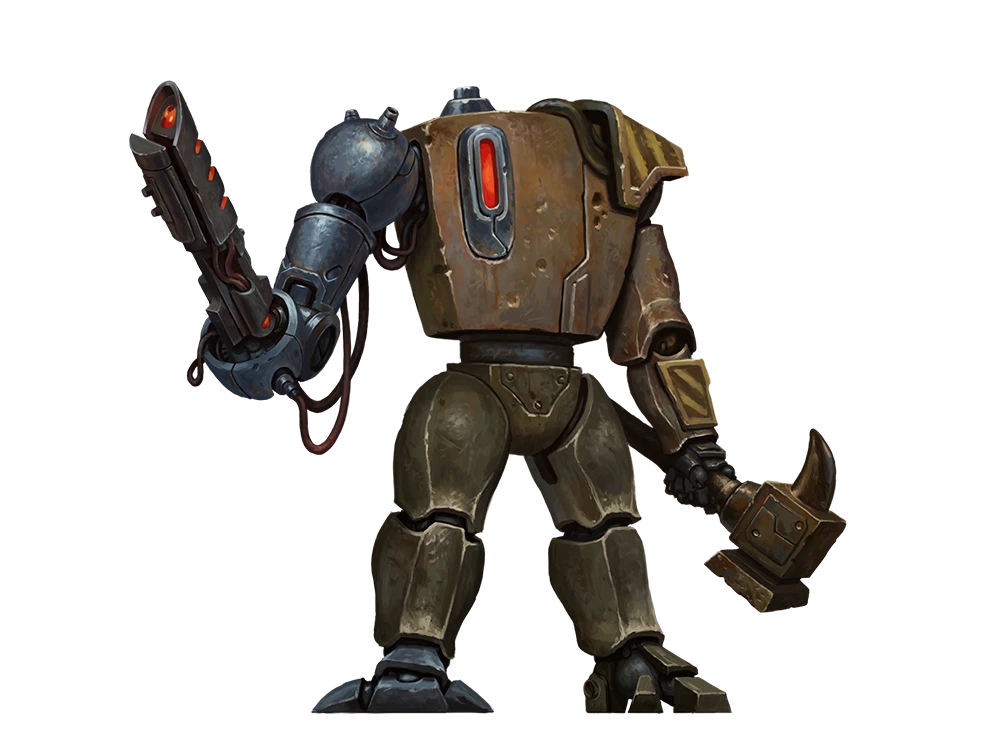
Most line-class soldier robots are lanky, headless humanoid machines. They have four-fingered hands and armored torsos painted in their owner's livery, with a single red sensor in the upper torso. By default, they're armed with bargain-brand laser rifles and breaching hammers. Each is 5 feet tall and weighs 300 pounds.
Line soldiers are the final refinement of the soldier robot concept, made dangerous through their simplicity. Line-class robots can be adapted to any battlefield, download skill packages via infosphere, cannibalize damaged allies for repairs, and are simple to make, maintain, and modify. As such, they are relatively cheap to purchase in large numbers and can be deployed with little regard for casualties.
Elite |
Normal |
Weak
Recall Knowledge
DC
16
18
19
•
Construct (Arcana)
Construct (Crafting)
Robot (Computers)
Robot (Crafting)
Str +3
Dex +4
Con +2
Int -1
Wis +1
Cha +0
HP 56
Immunities bleed,
death effects,
disease,
doomed,
drained,
fatigued,
healing,
mental,
nonlethal attacks,
paralyzed,
poison,
sickened,
spirit,
unconscious,
vitality,
void Formation When a line-class soldier robot is adjacent to at least two other allies, the robot gains a +1 circumstance bonus to AC and saving throws. This bonus increases to +2 for Reflex saves against
area effects.
Speed 30 feet
Melee
[one-action]
hammer
+11
(analogshove),
Damage 1d8
+6 bludgeoning
Field Repairs
[two-actions]
(manipulate)
Frequency once per 10 minutes;
Effect The line-class soldier robot salvages an adjacent corpse of a
tech creature that was destroyed no more than 1 month ago to regain 18 Hit Points.
All Creatures in "Robot, Soldier"
Living soldiers are a liability. They have families who don't want them to die, need salaries, have morale, require discipline, commit atrocities, and have opinions on the war. They're a necessary, but unfortunate, part of warfare for any society without an abiding love for necromancy.
Cutting-edge soldier robots promise to solve this problem. Soldier robots have no loved ones, opinions, self-preservation instinct, or tendency toward random atrocities. Many companies market their soldier robots as a humane solution to modern combat.
In practice, they're anything but.
Without lives on the line, soldier robots encourage their owners to engage more often and more violently. Standoffs turn into skirmishes, skirmishes into battles, and inevitably the innocent are caught up in the mix. They're particularly popular with corporations and non-governmental organizations that appreciate being able to throw a dozen soldier robots at any naysayer, public critic, or explorer they dislike while being able to deny true responsibility for what happens.
Though there's constant public fear of soldier robots going rogue, it has yet to prove a serious concern. If a soldier robot wants you dead, it's because someone doesn't mind if it kills you.
 Line-Class Soldier Robot
Creature 3
Line-Class Soldier Robot
Creature 3
 Combat Computers
 Gideron Authority